
The good news is that the language is not actually hard, and the staff is there specifically to help you learn it. The other good news is that the people who walk into Meadows for the first time are usually shopping for the same handful of things, which means you are not nearly as alone as you feel.
This guide is written from the perspective of the Meadows budtender team. Not the marketing version of how a dispensary visit goes. The real version. We answer the questions that first time customers actually ask, in the order they usually ask them.
We will cover what to expect when you walk in, the difference between flower and edibles and concentrates and cartridges and pre rolls, what indica and sativa actually mean in 2026, how to read a label, how much you should buy on your first visit, what to bring with you, and how to get the most out of the conversation with your budtender. By the end you should feel comfortable walking through the door without the quiet anxiety that almost everyone has on visit number one.
One quick note before we start. Cannabis is legal in Colorado for adults 21 and older. Everything in this guide assumes you are visiting a recreational dispensary, which is what Meadows is. Medical cannabis has its own separate set of rules, products, and pricing structures. The two markets overlap in many ways but operate differently at the legal and tax level. If you have a Colorado medical card, ask the budtender how that affects your purchase.
What to Expect When You Walk In
The first thing you see when you walk into Meadows is a check in counter, sometimes called a vestibule. This is where every visit starts. A team member greets you, asks for your government issued photo identification, and verifies that you are 21 or older. Acceptable forms of ID include a driver license, state ID card, passport, or military ID. Your ID has to be valid and not expired. We cannot make exceptions on this. Colorado state law requires verification at every visit, every time, including for customers who have been coming in for years.
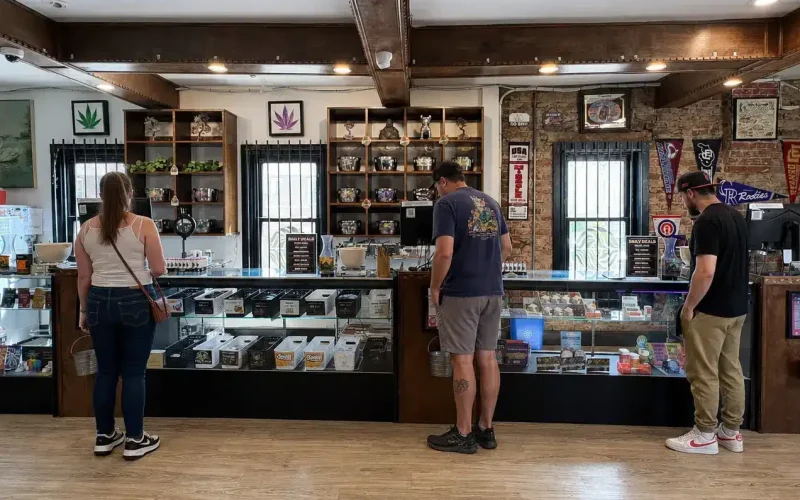
Once you are checked in, you move into the main retail floor. The retail floor is a single room with product cases along the walls, consultation areas where you can sit or lean while you talk to a budtender, and a check out counter where you pay. Everything is well lit, clean, and arranged so that you can browse without feeling crowded. Meadows specifically has wide aisles and clear sight lines, which is important on a busy weekend afternoon when there are several customers moving through the space at once.
A budtender will greet you and ask what brought you in today. This is the most important moment of the visit, and most first time customers underuse it. The budtender is not asking what you want to buy. They are asking what experience you are looking for, what you have tried before, and how confident you are in the product category you are interested in.
Be honest with this answer. If you have never used cannabis before, say so. If the last time you smoked was twenty years ago at a college party, say that. The product landscape has changed dramatically since the early 2000s, and the budtender’s recommendations will be much better calibrated if they know your starting point.
The conversation usually takes between three and ten minutes for first time visitors. The budtender will walk you through a few product categories, explain the relevant differences, and help you narrow down a recommendation. Once you have made your selection, you move to the check out counter, present your ID one more time, pay, and walk out with your purchase in a sealed bag.
Total visit time for a first time customer is typically between fifteen and twenty five minutes. Returning customers often complete a visit in five minutes or less.
The Five Main Product Categories Explained
Cannabis at a Colorado dispensary is sold in five main product formats. Understanding the differences is the foundation of every other decision you make on the visit.
Flower
Flower is the dried, cured cannabis bud that you smoke or vaporize. It is the original cannabis product and still the most popular category by volume. Flower is sold by weight, typically in increments of one gram, an eighth (3.5 grams), a quarter (7 grams), a half ounce (14 grams), or a full ounce (28 grams). The strain name on the label tells you which specific cultivar you are buying, and each strain has its own flavor, aroma, and effect profile.
To consume flower, you need to grind it and pack it into a smoking device, usually a glass pipe, a water pipe, or a rolling paper for a joint. You can also use a dry herb vaporizer, which heats the flower without combustion. Smoking and vaporizing flower delivers the fastest onset of effects, usually within minutes, and the effects last between one and three hours.
Flower is the right starting point for someone who is comfortable with smoking and wants the most traditional cannabis experience. It is also the category where the conversation with your budtender pays off the most, because the differences between strains can be subtle and personal.
Edibles
Edibles are food or drink products infused with cannabis. The most common formats are gummies, chocolates, baked goods, beverages, and capsules. Edibles bypass the lungs and deliver THC through the digestive system, which means the onset is much slower and the effects are much longer than with smoking.
The big rule with edibles is to start low and go slow. A standard single dose in Colorado is ten milligrams of THC, but most experienced consumers find that five milligrams is enough for a noticeable effect, especially the first few times.
Edibles take between forty five minutes and two hours to take full effect, and the effects can last four to eight hours depending on dose and individual response. The most common first time edible mistake is taking another dose because the first one did not seem to work, only to find both doses kick in at the same time.
Edibles are the right choice for someone who does not want to smoke, who wants longer lasting effects, or who wants a discreet way to consume cannabis without the smell or visible smoke.
Concentrates
Concentrates are extracted forms of cannabis that contain much higher levels of THC than flower. Common concentrate formats include wax, shatter, live resin, rosin, budder, and crumble. The textures vary depending on the extraction method, but the underlying product is the same idea: a concentrated cannabis extract that delivers a much stronger effect per gram than flower.
Concentrates are typically consumed by dabbing, which involves heating the concentrate on a hot surface and inhaling the vapor through a specialized water pipe called a rig. Dabbing requires equipment and some technique, which makes concentrates less beginner friendly than flower or edibles. The effects of dabbing come on fast and hit hard.
Concentrates are not the right starting point for most first time customers. They are an excellent product for experienced consumers who want efficiency and intensity, but the learning curve is real and the dose forgiveness is low.
Cartridges and Vapes
Cartridges, sometimes called carts or vape pens, are pre filled containers of cannabis oil that attach to a battery. You inhale through a mouthpiece and the battery heats the oil, producing vapor that you breathe in like you would with flower. Cartridges are convenient, discreet, and have very little smell.
The cartridge category is one of the fastest growing in Colorado because of how easy it is to use. You twist the cart onto the battery, press a button or just inhale, and the device handles the rest. Cartridges are sold by oil volume, typically half gram or full gram. The strain or flavor profile is listed on the package.
Cartridges are an excellent first time option for someone who wants the quick onset of inhalation without the equipment requirements of smoking flower. Quality matters in this category, so stick to cartridges from reputable Colorado brands and avoid any product that does not have clear lab testing information on the package.
Pre Rolls
Pre rolls are joints that have been rolled by the dispensary or the producer in advance. You buy a pre roll, walk out, light it, and smoke it. No equipment, no rolling skill, no extra steps. Pre rolls are sold individually or in multi packs, and they range in price from the three dollar singles at Meadows up to fifteen or twenty dollars for premium infused options.
Pre rolls are the most beginner friendly form of smokable cannabis. The format eliminates the equipment question and lets you focus on the experience itself. For a first time visit, picking up a single pre roll along with whatever else you are buying is a low risk way to try a strain without committing to a full eighth of flower.
Indica, Sativa, and Hybrid: What These Words Actually Mean in 2026
For decades, cannabis has been classified into three main categories: indica, sativa, and hybrid. The shorthand most people learned is that indica is for relaxation and sleep, sativa is for energy and creativity, and hybrid is somewhere in the middle. This shorthand is still useful, but it is not as scientifically clean as it used to sound.
Modern cannabis researchers have largely moved past the strict indica versus sativa division. The plants we sell today are nearly all hybrids at the genetic level, and the actual effects are driven much more by the specific cannabinoid and terpene profile of the strain than by the indica or sativa label. Two different strains both labeled indica can produce different effects, and the most reliable way to predict how a strain will feel is to look at its full chemical profile.
That said, the indica, sativa, and hybrid categories still work as a useful starting framework, because most strains do follow the traditional pattern in a general way. If you tell your budtender you want something for evening relaxation, they will lead you toward the indica forward end of the menu. If you want something for a daytime hike, they will point you toward sativa forward options. The categories are imperfect but functional, and they are how most dispensary menus are still organized.
The terpene profile is the next layer of detail. Terpenes are the aromatic compounds in cannabis that produce flavor and contribute to the effect.
Myrcene is associated with relaxation and the classic earthy cannabis smell. Limonene is bright and citrusy and tends to feel uplifting. Pinene is piney and sometimes feels clarifying. Linalool is floral and lavender like and is often found in calming strains. As you get more comfortable with cannabis, paying attention to terpenes is one of the most useful skills you can develop, because it helps you predict effects across very different strain names.
How to Read a Cannabis Product Label
Every legal cannabis product in Colorado has a standardized label that tells you exactly what is in it. Once you understand the label, you can shop confidently anywhere in the state.
The strain name is the most prominent text on the label. This is the marketing name of the specific cultivar, like Blue Dream, OG Kush, Wedding Cake, or any of thousands of others. Strain names are not regulated, which means two different growers can use the same name for slightly different products. Treat the strain name as a starting hint, not a guarantee.
The THC and CBD percentages tell you the cannabinoid profile. THC is the primary psychoactive compound. CBD is non intoxicating and has its own set of effects. A flower product might list 22 percent THC and less than 1 percent CBD, which is a typical recreational strain profile. An edible will list total milligrams per package and per individual piece, like 100 milligrams per package and 10 milligrams per gummy.
The terpene profile, when listed, shows the dominant aromatic compounds. Not every label includes terpene data, but premium brands often do. Look for the top two or three terpenes and use them to predict the experience.
The lab testing information confirms the product was tested for potency and contaminants. Reputable Colorado brands include the testing lab name and the batch number on the label. If a product has no testing information, that is a red flag.
The state required warnings appear at the bottom of every label. These include the universal Colorado cannabis symbol, the warning about driving and operating machinery, and the warning about consumption during pregnancy. The warnings are required by law and are the same on every product.
How Much Should a Beginner Buy on Their First Visit?
This is the question every first time customer asks, and the answer is less than you think. The most common first time mistake is buying too much, often because the prices look good or the recommendations sound exciting. Cannabis stays fresh longer than most fresh products but loses quality over weeks and months, so buying more than you can use within a reasonable window does not actually save you money.
For a first time customer who has never tried cannabis or has not used it in many years, a reasonable starter purchase looks like this. One pre roll, ideally a half gram or full gram, in a strain the budtender recommends based on your goal. One package of low dose edibles, ideally something in the five milligram per piece range. Optionally, a small amount of flower, like a gram, if you have a way to consume it.
This entire bundle costs between twenty and fifty dollars depending on selection, and it gives you enough variety to learn what you like without overcommitting to any single product.
For someone with previous cannabis experience who is just new to the legal dispensary system, the smart approach is similar but with slightly larger quantities. An eighth of flower is the standard purchase unit. A package of edibles you trust. A cartridge if you use one.
The first visit should still be exploratory rather than a full month of stocking up. Buy what you need to learn what is on the shelf at this specific dispensary, then come back for the larger restock once you know your favorites.
Avoid the urge to buy across every category on the first visit. You will end up with products you do not get around to using, and the expiration dates and freshness windows are real. Better to make two or three smaller visits over your first month than one large visit that produces a stockpile you have to work through.
What to Bring on Your Visit
The list of what to bring is short. Your government issued photo ID is mandatory. We cannot serve you without it, no matter how recently you were last in. Cash is preferable for payment because cannabis retailers cannot accept most credit cards due to federal banking restrictions. Debit cards work at most dispensaries with a small transaction fee, and there is an ATM on site at Meadows if you forgot to stop at the bank.
Bring questions. Write them down if you think you will forget. The budtender team is genuinely interested in answering questions, and the visit goes better when you arrive with a clear sense of what you want to learn.
Leave your expectations at the door. Cannabis affects different people differently, even within the same product category and same dose. A first time visit is the start of an exploration, not a guarantee of a specific outcome. The customers who get the most out of their first visit are the ones who treat it as a learning conversation rather than a transaction.
The Role of the Budtender
The budtender is the single most underused resource in a Colorado dispensary visit. New customers often treat the budtender like a cashier or a stocker, when in reality they are closer to a sommelier or a specialty bookstore employee. A good budtender has tried most of the products on the shelf, knows the producers personally, and can match a recommendation to your specific goals in a way that no website or printed menu ever will.
Treat the budtender like the expert they are. Tell them honestly what you want. Tell them what you have tried before and what you liked or did not like about it. Ask follow up questions. The conversation is the value, and the product is downstream of the conversation. Customers who learn to use their budtender well end up with much better cannabis experiences than customers who shop purely from the menu.
At Meadows specifically, our team is trained to slow down for first time customers. There is no pressure to make a decision quickly, no upselling toward higher priced products, and no judgment about questions that feel basic. Every regular started as a first time customer once. We remember what it was like, and we calibrate accordingly.