
Walking into a dispensary for the first time looking for CBD can feel like trying to read a menu in a language you have not studied yet. Full spectrum, broad spectrum, isolate, tincture, sublingual, milligrams per milliliter, terpenes, the entourage effect. There is a lot of vocabulary stacked on top of what should be a simple question. Where do I start?
This guide is built to answer that question without overcomplicating it. By the end, you will know exactly how much CBD to take on day one, which product format fits your routine, how long to wait before judging the results, and what to keep an eye on for safety. Everything here is based on the dosing frameworks that experienced clinicians and the largest CBD reviewers consistently recommend. Start low, go slow, and pay attention to your body.
Quick note before we start. CBD products sold outside a pharmacy are not FDA-approved, and nothing in this article is medical advice. If you take prescription medication or have a medical condition, talk to your doctor before adding CBD to your routine. Sources are linked at the bottom of this article.
What CBD Actually Is (And What It Is Not)
CBD, short for cannabidiol, is one of more than 100 naturally occurring compounds in the cannabis plant. The other one most people have heard of is THC. CBD and THC are chemical cousins, but they behave very differently inside your body.
THC is psychoactive. It produces the “high” people associate with cannabis. CBD is non-intoxicating. It will not get you high, it will not impair your driving, and it will not change how you think or feel in the dramatic way THC can. What CBD does, according to a growing body of research, is interact with your endocannabinoid system, a network of receptors that helps regulate sleep, mood, appetite, immune response and how your body processes stress.
People reach for CBD for a few common reasons:
- Help winding down at the end of the day
- Support for occasional sleep difficulty
- Relief for everyday muscle and joint discomfort, especially after exercise
- A non-intoxicating alternative to THC for stress and mood support
One important caveat from the FDA. The only CBD product the agency has approved is a prescription medication called Epidiolex, used to treat specific seizure disorders. The CBD gummies, tinctures and creams on dispensary shelves are sold as wellness products, not medicines, and they cannot legally claim to treat or cure any condition. That does not mean they are not useful. Millions of people use them and report real benefits. It just means you should set expectations accordingly.
If you have never set foot inside a dispensary at all, our team also wrote a complete first-timer’s guide to walking into a Denver dispensary that pairs nicely with this article.
The Golden Rule of Starting CBD: Start Low and Go Slow
Almost every CBD physician, pharmacist and longtime user converges on the same advice, often summarized in four words. Start low, go slow.
The reason is biological. Everyone’s endocannabinoid system is slightly different, which means the dose that works perfectly for your friend might be too much, too little, or wrong for you. There is no universal CBD dose. Effective amounts in published clinical studies have ranged anywhere from 10 mg to over 1,500 mg per day, depending on the person and the condition.
Starting low gives you three advantages at once. You minimize the chance of side effects, you give yourself room to feel small changes, and you learn what your personal “sweet spot” is. That sweet spot is the dose where adding more does not add more benefit, and it is the only dose that matters in the long run.
Beginner Dosage Framework
Here is the framework most experienced users land on after their first month of experimentation. Pick the row that roughly matches your situation, start at the low end, and hold that dose for 5 to 7 days before adjusting.
| Body Weight | Mild Goals (daily wellness, light stress) |
Moderate Goals (sleep, post-workout) |
Stronger Goals (chronic discomfort) |
|---|---|---|---|
| Under 130 lbs | 5 to 10 mg | 10 to 20 mg | 20 to 30 mg |
| 130 to 230 lbs | 10 to 15 mg | 15 to 30 mg | 30 to 45 mg |
| Over 230 lbs | 15 to 20 mg | 20 to 40 mg | 40 to 60 mg |
These ranges are general starting points, not prescriptions. Always begin at the lower end of your row, especially if it’s your first week. Adjust in 5 mg increments after 5 to 7 days of consistent use.
The most common beginner dose across nearly every reputable source is 10 mg once a day. A single 10 mg full-spectrum gummy or half of a 25 mg gummy is a perfectly reasonable starting point regardless of your body weight, especially if you have never used cannabinoids before.
Choosing Your First CBD Product: A Side-by-Side Comparison
The single biggest decision you will make as a new user is the format, meaning how you deliver CBD into your body. Each format has different onset times, different durations, and different ideal use cases. Here is how they compare.
| Format | Onset | Duration | Best For | Beginner Friendly? |
|---|---|---|---|---|
| Tincture / Oil under the tongue |
15 to 45 min | 3 to 6 hours | Precise dosing, daily routine, adjusting in small fractions | Excellent |
| Gummies / Edibles | 30 to 90 min | 4 to 8 hours | Convenience, predictable dose per piece, on-the-go use | Excellent |
| Capsules / Softgels | 30 to 90 min | 4 to 8 hours | Daily supplement routine, no taste, precise mg | Excellent |
| Topicals cream, balm, roll-on |
15 to 30 min local only |
2 to 6 hours | Targeted muscle or joint relief, no whole-body effect | Excellent |
| Vape / Inhalable | under 5 min | 1 to 3 hours | Fastest onset, acute stress moments | Use with caution |
| Beverages seltzers, drinks |
15 to 45 min | 3 to 5 hours | Social setting alternative to alcohol | Good |
Which Format Should You Pick on Day One?
For most first-time users, the answer is one of two products.
A 10 mg gummy if you want the simplest possible introduction. The dose is pre-measured, the taste is pleasant, and there is no math involved. The trade-off is slower onset (30 to 90 minutes) and less ability to fine-tune the dose later.
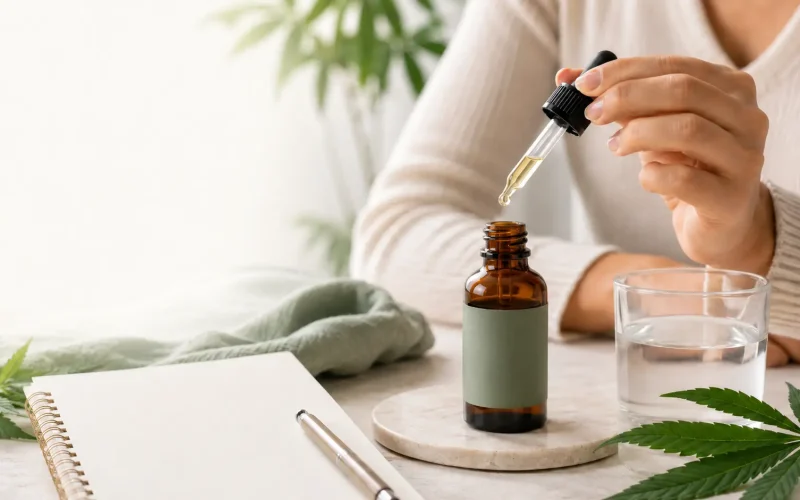
A low-strength tincture (usually labeled 300 to 600 mg per 30 mL bottle) if you want flexibility. Tinctures let you adjust by fractions of a dropper, which is invaluable when you are still figuring out your sweet spot. The onset is faster too, because the CBD absorbs through the blood vessels under your tongue rather than passing through digestion.
Topicals are also fantastic for beginners, but they solve a different problem. A CBD balm rubbed on a sore shoulder will not change how you feel in the rest of your body, because topicals act locally rather than entering the bloodstream in meaningful amounts. If your goal is targeted relief after a hike or a long bike ride around Wash Park, topicals are excellent. If your goal is general daily wellness, start with a gummy or a tincture instead.
We generally suggest beginners hold off on vapes and inhalables until they have a baseline established with a slower format. Inhalation gets CBD into your bloodstream faster than any other method, which sounds great until you realize that “faster onset” also means “less time to course-correct” if the dose was too much. Save it for once you know how your body responds.
Full Spectrum vs Broad Spectrum vs Isolate: What’s the Difference?
The other key vocabulary every beginner runs into is the spectrum of the product. This refers to which compounds from the hemp plant the manufacturer kept in the final formula.
Full Spectrum
Contains everything naturally found in the hemp plant. CBD, minor cannabinoids (CBG, CBN, CBC), terpenes, flavonoids, and trace amounts of THC (legally capped at 0.3 percent by dry weight). This trace THC is not enough to get you high, but it can produce a positive drug test in sensitive screenings. Many users find full spectrum produces the most noticeable effects, attributed to what researchers call the “entourage effect.” The idea is that the plant’s compounds work better together than in isolation.
Broad Spectrum
The middle ground. It keeps all the supporting cannabinoids and terpenes that drive the entourage effect, but the THC has been removed through an extra processing step. This makes it a strong option for people who want the richer plant profile but are concerned about drug testing or are sensitive to even trace THC.
Isolate
This is 99 percent pure CBD. Every other plant compound has been stripped out, leaving a tasteless, odorless crystalline powder that gets infused into oils, gummies and capsules. Isolate is the most predictable choice and the safest from a drug-testing perspective, but most experienced users find it produces a milder, more linear effect than full or broad spectrum at the same milligram amount.
| Type | Contains THC? | Entourage Effect | Best For |
|---|---|---|---|
| Full Spectrum | Yes (under 0.3%) | Strongest | Maximum effect, no drug testing concerns |
| Broad Spectrum | No | Strong | THC-sensitive users who still want a rich plant profile |
| Isolate | No | None | Strict drug testing, total predictability, cooking with CBD |
Our recommendation for most beginners. Start with a full spectrum product if drug testing is not a concern for your job. The richer effect typically makes the “did this actually do anything?” question much easier to answer in your first week.
Your First Two Weeks: A Day-by-Day Approach
The single biggest mistake new CBD users make is treating it like ibuprofen. Take it once, feel nothing dramatic, conclude it does not work. CBD is a compounding supplement. Some effects show up quickly, but most users report that the meaningful benefits build over 2 to 4 weeks of consistent daily use.
Here is a practical two-week onboarding plan.
Days 1 to 3: Find your floor
Take 10 mg once per day, at the same time every day. Most people find this works best with breakfast (food helps absorption) or about an hour before bed if sleep is the goal. Do not stack, do not skip, do not increase yet.
Days 4 to 7: Stabilize and observe
Stay at 10 mg. Start a short journal. Three lines per day is enough. Note the time taken, format, how you felt one hour later, sleep quality that night, and energy the next morning. Patterns become obvious quickly when you write them down.
Days 8 to 14: Adjust if needed
If you feel a noticeable, positive shift, stay where you are. The goal is not the highest dose you can tolerate. It is the lowest dose that produces the effect you want. If you feel nothing or only a very subtle change, bump up by 5 to 10 mg and hold the new dose for another week before adjusting again.
Past two weeks: Find your sweet spot
Continue the 5 to 10 mg adjustments every 5 to 7 days until you find the dose where adding more does not add more benefit. That is your personal sweet spot, and for most healthy adults it lands somewhere between 15 mg and 60 mg per day. Once you find it, hold it.
If you ever land at a dose that is too much, usually signaled by drowsiness, mild stomach upset, or fatigue, reduce by half and wait 48 hours before continuing. Your body is telling you something specific, and the start low, go slow framework is designed exactly to catch that signal early.
What CBD Feels Like (And What It Does Not Feel Like)
This is the part most articles skip, and it is one of the most useful things to know going in.
CBD does not produce a “rush.” There is no head change, no euphoria, no perceptual shift. For many people, the first impression is faintly disappointing. They were expecting something, and instead they just feel normal. That is actually a sign the product is doing what it should.
What people typically describe after a few days of consistent use:
- A subtle lowering of the baseline mental “noise.” Easier to focus, less racing-thought spillover.
- Faster falling asleep at night and feeling less wired in the evening.
- Less morning stiffness or post-workout soreness.
- A general “evened out” feeling. Not a different mood, just a steadier one.
If you find yourself thinking “I’m not sure if this is working” by day 4, that is normal, that is most people, and it is exactly why the journaling step matters. Looking back at your notes after two weeks will usually tell a clearer story than your day-to-day perception.
Side Effects, Safety and Drug Interactions
The World Health Organization has concluded that CBD is generally well tolerated with a good safety profile at the doses studied. That does not mean it is risk-free. Possible side effects, mostly at higher doses, include:
- Drowsiness or fatigue
- Diarrhea or other mild GI upset
- Decreased appetite
- Dry mouth
- Changes in weight
If you experience any of these, reduce your dose by half and wait 48 hours. Almost all reported side effects resolve quickly at lower doses.
The Grapefruit Rule
The most important safety consideration for new users is drug interactions. CBD is metabolized in the liver by the same enzyme family (CYP3A4 and CYP2C19) that processes a long list of common prescription medications. When two substances compete for the same enzyme, the concentration of either one in your bloodstream can shift unpredictably.
Here is a useful shortcut from Harvard Health. If the label on your prescription medication warns against eating grapefruit, talk to your doctor or pharmacist before starting CBD. Grapefruit and CBD use the same liver pathway, so the warning translates directly. This applies to many blood thinners, statins, certain antidepressants, blood pressure medications, immunosuppressants, and some seizure medications.
Other groups who should consult a healthcare provider before starting CBD:
- Anyone who is pregnant or breastfeeding
- Anyone with significant liver concerns
- Anyone scheduled for surgery in the next two weeks
- Anyone whose employer conducts THC drug testing (use isolate or broad spectrum only)
How to Choose a Quality CBD Product
Not all CBD products are created equal. Colorado has stricter testing requirements than many states, but quality still varies between brands. Here is the short list of what to check before you buy.
- Certificate of Analysis (COA). A reputable brand publishes third-party lab tests showing exactly what is in the bottle. Cannabinoid content, terpene profile, and screens for pesticides, heavy metals and microbial contamination. If a brand does not have a current COA, walk away.
- Total mg of CBD, not just “strength.” A bottle labeled “1,000 mg” means the entire bottle contains 1,000 mg. To find your per-dose amount, divide total mg by the number of mL (for tinctures) or the number of pieces (for gummies).
- Spectrum clearly labeled. Full spectrum, broad spectrum or isolate should be stated plainly on the package.
- Source. Colorado-grown hemp is held to the state’s stricter cultivation standards. Look for brands that disclose where their hemp is grown.
- Simple ingredients. The best tinctures contain just two things. Hemp extract and a carrier oil (usually MCT from coconut). Avoid products with long flavoring lists, unnecessary additives or artificial sweeteners.
At Meadows, we hand-select every CBD product on our shelf and we are happy to walk you through COAs for anything you are curious about. If you live nearby, our Wash Park neighborhood discount takes 20 percent off the listed price.
Frequently Asked Questions
How much CBD should I take the very first time?
How long does it take to feel CBD?
Will CBD show up on a drug test?
Can I take CBD every day?
Should I take CBD in the morning or at night?
Can I take too much CBD?
What’s the difference between hemp-derived CBD and cannabis-derived CBD?
Visit Meadows in Wash Park
If you live in Denver and you have been curious about CBD but unsure where to start, come see us. Our budtenders take the time to actually understand what you are looking for, whether that’s sleep support, post-workout recovery, an alcohol alternative, or a daily stress baseline. They walk you through the options that fit. No pressure, no upsell, no rushing.
We are at 2215 E Mississippi Ave on the corner of Old South Gaylord, open seven days a week. You can also browse our CBD selection online and pick up your order in minutes.
Final reminder. Nothing in this article is medical advice. If you are taking prescription medication or managing a medical condition, please talk to your doctor before starting CBD. Start low, go slow, journal what you feel, and adjust based on your body, not on what worked for someone else.
Sources and Further Reading
- Project CBD. CBD Dosage Guidelines for Beginners
- Healthline. CBD Dosage: How Much Should You Take?
- Healthline. How Much CBD Should I Take the First Time?
- Harvard Health Publishing. CBD and Other Medications: Proceed with Caution
- U.S. Food and Drug Administration. What You Need to Know About CBD Products
- National Library of Medicine (NIH). Cannabidiol Adverse Effects and Toxicity
- WebMD. Cannabidiol (CBD): Uses, Side Effects and Interactions
- World Health Organization. CBD Critical Review Report